Desk setup guide

How to work from a bed or sofa without wrecking your back

Every ergonomics guide tells you not to do this. You are going to do it anyway, so here is how to do it properly.

5 fixes No desk required Renter-friendly

Heads up: the product links on this page are affiliate links. If you buy through one, Ratrendyshop earns a small commission - at no extra cost to you. We only list things we would put on our own desk.

The advice is always the same: don't work from bed, don't work from the sofa, use a proper desk. It is good advice and almost nobody follows it, because sometimes the desk is occupied, or the room is cold, or you are ill, or the sofa is simply where you are.

So the useful question is not whether to do it. It is which parts of it actually cause the damage — and those turn out to be specific and fixable. Screen height, arm support, light, and noise. In that order.

01

Give the laptop something to sit on that isn't you

The reason working from bed hurts is not the bed. It is that the laptop sits on your thighs, which drops the screen roughly forty centimetres below eye level and rolls your shoulders forward to reach the keyboard. An hour of that is a sore neck.

A wedge support pillow raises the laptop to somewhere near lap-desk height and gives your arms a surface to rest on, so the weight is carried by the pillow rather than your shoulders.

One honest limitation: The manufacturer says it plainly — it is foam, not furniture. It supports a laptop and your forearms. It is not a desk, and a heavy gaming machine is asking too much of it.

A grey memory foam support pillow holding a laptop on a sofa

Reading & Working Support Pillow

Extra large. Arm rests plus two side pockets.

Check current price
02

Solve the light before you solve anything else

Sofas and beds are lit for relaxing, not for reading a screen. Which means you are almost always working in a dim room with a bright laptop — the exact combination that tires eyes fastest.

The complication is that there is rarely a socket where you are sitting. A cordless lamp is the only version of this fix that survives contact with a sofa.

Why cordless is not a luxury here: At a desk you can run a cable. On a sofa, a lamp that needs a socket is a lamp you will not move, and a lamp you will not move is a lamp you stop using.
A cordless LED lamp on a side table beside a sofa

Working from bed? Fix the lighting first

Solve the light before you solve anything else.

Check current price
03

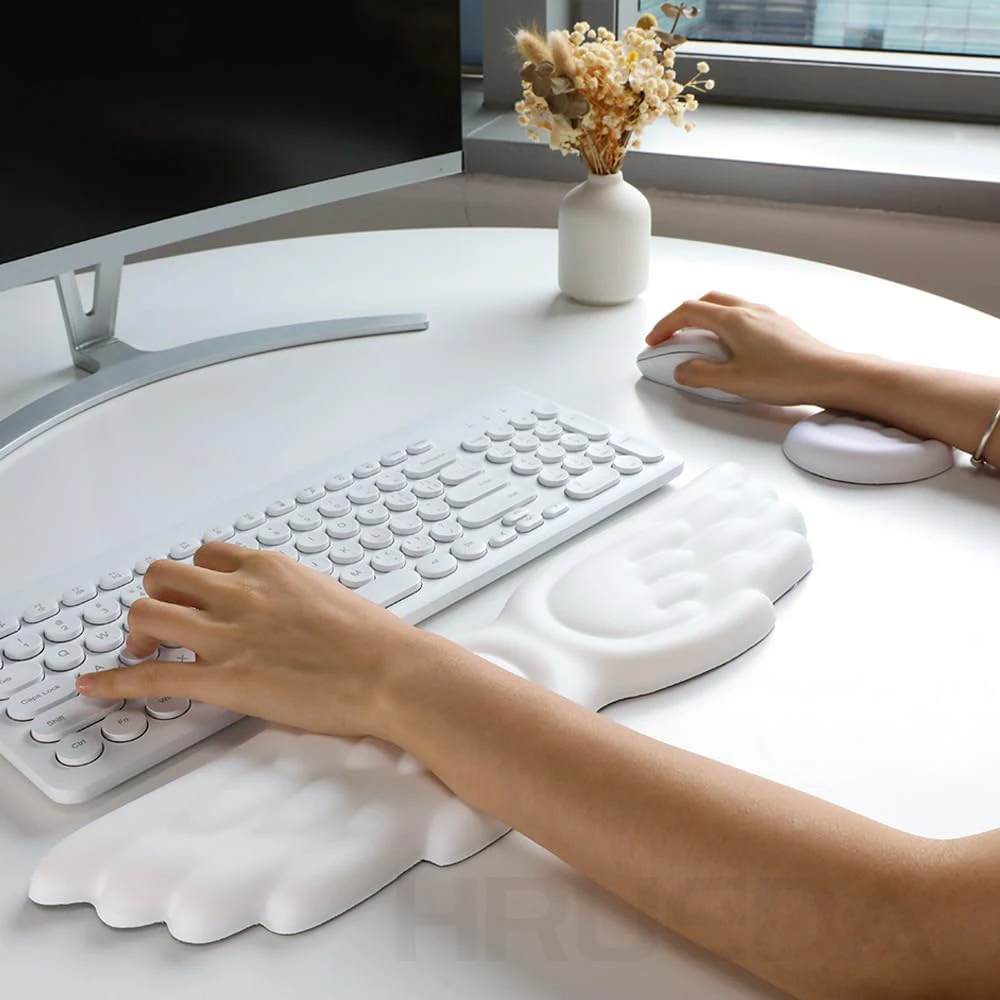
Get the wrists off the hard edge

A laptop resting on a pillow puts the keyboard at a slight angle, and your wrists take the contact at the front edge. Over a long session that edge is what you will feel, not the typing.

A pair of foam rests sits in front of the keyboard and lifts the wrists level with it. On a sofa this matters more than at a desk, because you cannot adjust the height of anything else.

Get the pair: The mouse hand does this too, and if you are working from a sofa you are probably using a trackpad — which means one wrist is doing everything.
A memory foam wrist rest set in front of a keyboard

Typing in bed? Fix your wrists first

Get the wrists off the hard edge.

Check current price
04

Deal with the fact that this room is not an office

The bed and the sofa are usually in the parts of the home where other people are. That is the real cost of working there — not comfort, but interruption.

A steady sound floor covers the small noises that make you look up: a door, a conversation in the next room, footsteps. It does not make the room quiet. It makes the room consistent, which is what concentration actually needs.

The honest trade-off: Working from a sofa will never be as focused as working from a closed room. This narrows the gap; it does not close it.
A small white noise machine on a side table

Working from the sofa in a full house

Deal with the fact that this room is not an office.

Check current price
05

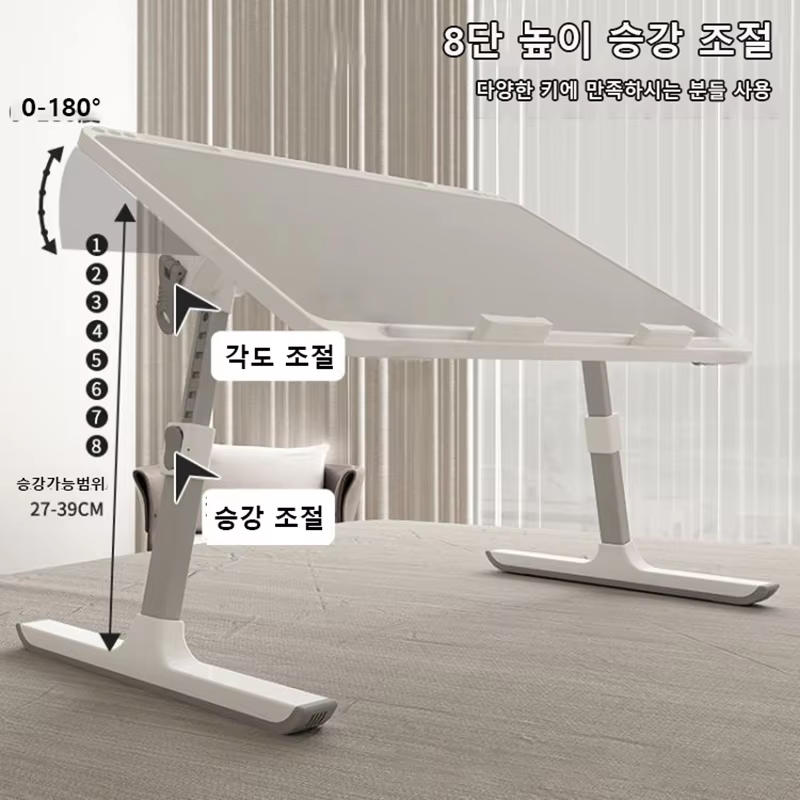
When the pillow is not enough, get an actual table

The pillow in step one earns its place for a thin laptop and an hour or two. It runs out of room fast — there is nowhere for a mouse, a phone, or a mug, and foam has no drawer, no fixed angle, and no memory of where you last set it.

A folding tray table replaces the pillow entirely once a session runs long: a rigid surface that clears your legs completely, adjusts through eight height positions (27–39cm), and tilts flat to 180°. A narrow drawer underneath holds the small stuff the pillow never could.

Measure before you buy: At 60×40cm it is sized for a bed, not a single sofa cushion — check your actual space against the footprint before ordering, or it ends up parked on the floor instead of over your lap.
A white adjustable laptop tray table set up over a bed, tilted at an angle

Working from bed long-term? Skip the pillow

Folding tray desk with 8-position height and a drawer.

Check current price

What this setup is not

  1. It is not a replacement for a desk. If you work eight hours a day, five days a week, none of this substitutes for a chair and a table at the right height.
  2. It is not for a heavy laptop. Foam supports a thin laptop and your forearms. A large gaming machine will sink into it.
  3. It is a way to make the hours you spend here less costly. Which, for most people, is the honest goal.